
section-6abc8b2
About the Marsala Stagnone
La Stagnone Islands Oriented Nature Reserve is one of the first reserves established in Sicily (1984).
The unspoiled nature, crystal-clear waters, land rich in history and archaeological remains, along with the still active salt pans with their windmills, make this place unique and enchanting.
The body of water of the Stagnone Lagoon, bounded by the open sea through Isola Lunga, encloses the three islets: Mozia, Saint Mary's e Schola.
Halophilous plants grow along the salt marsh channels, including. suaeda maritima, glasswort, salsola soda, limonium, classroom e limoniastrum.
As early as July, the Stagnone welcomes autumn migratory birds, such as chiurli e mignattai. During the cold season, the reserve becomes a habitat for numerous species of waterfowl, including mallards, coots, teal, ladles, gadwall, pochards, garganeys e marsh harriers.
Embellishing the landscape of the salt marshes are the herons, majestic and proud, whose splendid colors enrich the scenery as they scour the area in search of food.
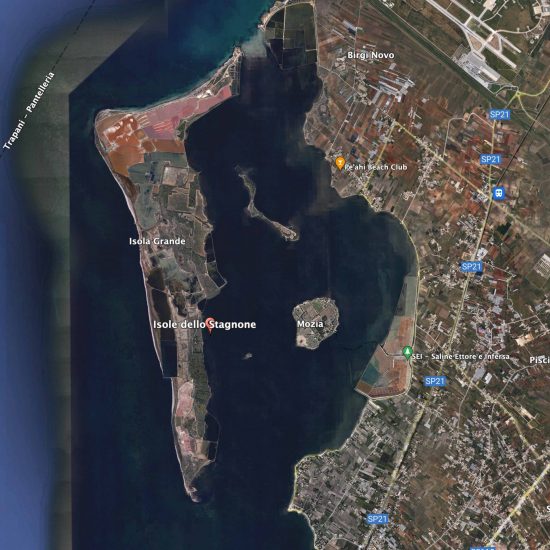
The reserve is characterized by shallow waters, which can be crossed on foot in some places, and warm, calm waters that make kayaking the best way to explore it safely. The Stagnone Lagoon covers an area of 2,000 hectares, between Punta San Teodoro e Cape Lilybaeum.
It is the largest lagoon in Sicily, with an environment of enormous naturalistic interest and scenic beauty. It is managed by the Free Municipal Consortium of Trapani (former Regional Province of Trapani).
🧂 The Salt Pans and the Alofila Vegetation.
The salt pans, still in operation, are managed using traditional methods. The strongly brackish environment is the realm of the Chenopodiaceae: Along salt marsh banks and in temporary salt marshes, this family of halophilic plants shows a wide variety of species belonging to numerous genera, including:
- Salicornia
- Arthrocnemum
- Halopeplis
- Halocnemum
- Suaeda
- Salsola
- Atriplex
- Halimione
Of particular note is the presence within the Reserve's boundaries of numerous rare plant species, considered among the most vulnerable to extinction and included in the "Red Book of the Plants of Italy.", including:
- Halocnemum strobilaceum
- Halopeplis amplexicaulis
- Aeluropus lagopoides
- Limoniastrum monopetalum
- Limonium ferulaceum
- Marigold maritima
🦅 The Avifauna of the Reserve.
The avifauna is also rich and diverse, with a large presence of migratory birds, including:
- Knight of Italy
- Egrets
- Herons
- Royal Pythias
- Small Piro piro
- Wild ducks
Breeding birds include:
- Greenback
- Strillozzo
- Goldfinch
- Chaplet
🐟 Posidonia Prairies and Marine Fauna.
Splendid are the posidonia meadows, which cover much of the lagoon bottom. The warm, shallow waters provide an ideal habitat for a rich fish fauna.
🛶 The Punic Road and Kayak Excursion.
At about 3 km north of the historic pier, lies the ancient connection with theisland of Mothia, known as the "Punic Road", now submerged below the water level. The kayak excursion allows you to sail along a section of this route, admiring the ancient work and its fascinating manufacture up close.